Alto Alentejo · Portugal
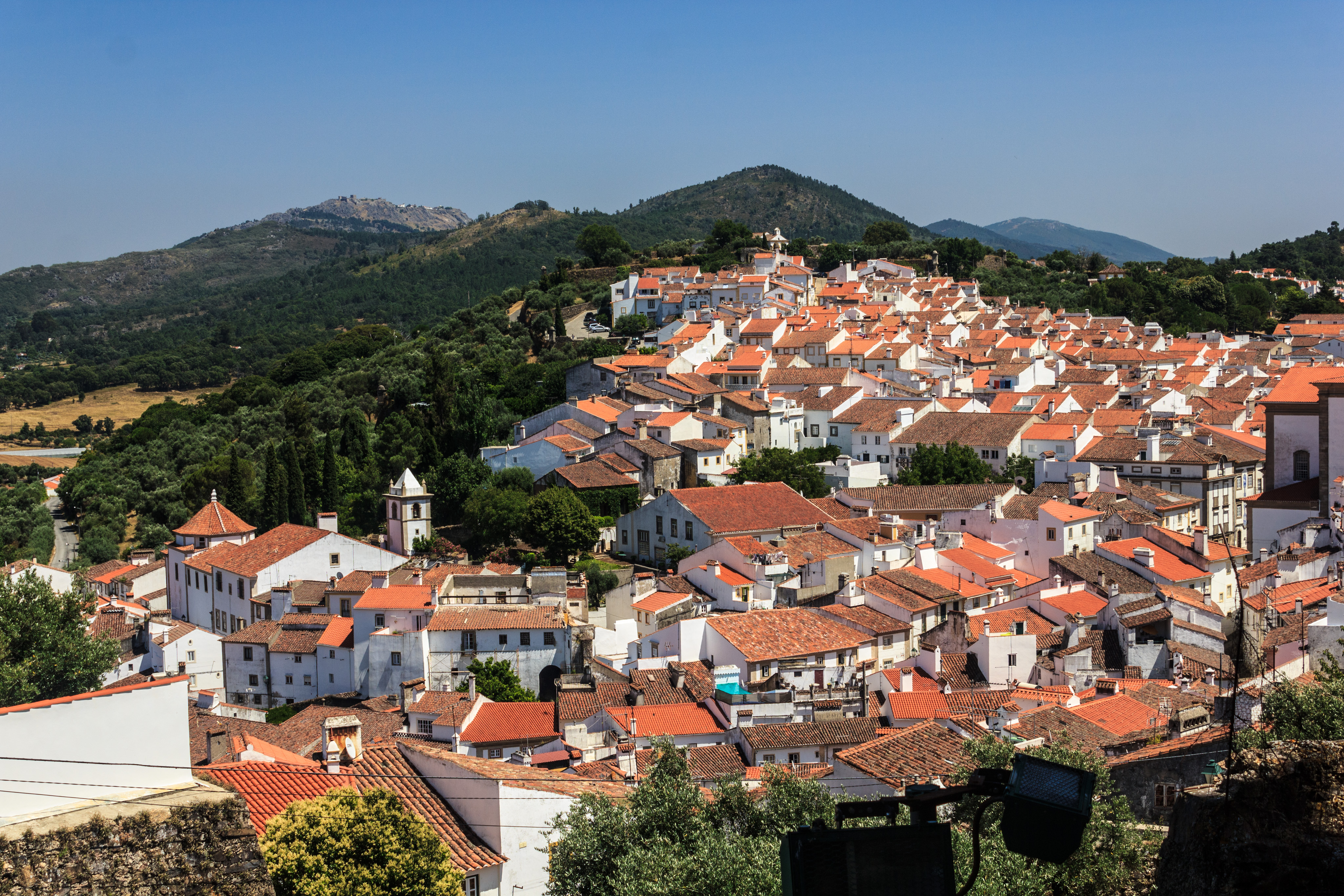
Castelo de Vide
Seven thousand years in one walled town — from the world's oldest precisely dated standing stone to the still-inhabited cobbled lanes of the Jewish quarter.
- ~5000 BC
- first standing stone
- 9
- visitable eras
- 2.5 km
- wall circuit
- 1276
- municipal independence
Castelo de Vide is a walled medieval town in the Alto Alentejo, inside the Serra de São Mamede Natural Park. Its history does not begin with the castle: it begins nearly seven thousand years earlier, with stones raised along the Sever river.
This guide tells that history as one continuous line of nine eras. None outweighs another — each left remains you can visit, or streets people still live in.
9 eras
Nine eras, one territory
Walk the full timeline. Every era has its own page, with what still stands and where to see it.
- Read the era01
from ~5000 BC
Prehistory & Megaliths
The Menir da Meada is the largest fully human-carved menhir in the Iberian Peninsula — and, by radiocarbon dating, the oldest precisely dated standing stone in the world.
- Read the era02
1st c. BC – 6th c. AD
Romanization — Ammaia
The Roman city of Ammaia, founded around the turn of the millennium, sits just outside Castelo de Vide inside the Serra de São Mamede Natural Park.
- Read the era03
6th – 12th c.
Late Antiquity to the Reconquista
Between the Roman withdrawal and the Christian Reconquista lies a documentary gap — yet recent archaeology shows early medieval occupation of the territory.
- Read the era04
13th – 14th c.
Medieval Founding — the Castle
Castelo de Vide gained municipal independence from Marvão in 1276. Under King Dinis the castle was built up and the keep raised.
- Read the era05
14th – 15th c.
The Jewish Quarter
Considered the best-preserved Jewish quarter ensemble in Portugal: ogival doorways, cobbled lanes, and the 14th-century Synagogue.
- Read the era06
1640 – 1668
Frontier and Fortification
The Portuguese Restoration War triggered a long campaign of fortification works, with military engineers introducing French and English bastioned innovations.
- Read the era07
14th – 19th c.
Religious Heritage
From the Capela de São Roque tucked into a street crossing to the parish church of Santa Maria da Devesa, whose dedication is unique in Portugal.
- Read the era08
1706 – 1990s
Waters, Spa, and the 20th Century
The therapeutic properties of the waters were only scientifically recognized in 1918. In 1940, a thermal bathhouse began to rise 20 metres from Fonte da Vila.
- Read the era09
present
Castelo de Vide Today
A living town inside the Serra de São Mamede Natural Park, known as “the Sintra of the Alentejo”.
Routes
Thematic routes
Eight guides to cross the town by theme: water, walls, megaliths, Jewish heritage, churches, landscape.
- Guide
On foot · half a day
Classic historic-centre route
Castle → Judiaria → Synagogue → Fonte da Vila → main square. The most direct reading of the walled town.
- Guide
On foot · 2–3 hours
Guide to Fountains & Fontanários
The town can be read through its water: from the 16th-century Fonte da Vila to small street fountains and the old thermal bathhouse.
- Guide
On foot and by car · half a day
Guide to Churches & Chapels
Five centuries of religious architecture, from a street crossing to the top of the ridge.
- Guide
On foot · 2 hours
Guide to the Judiaria & Jewish Heritage
Synagogue-museum, ogival doorways, and Fonte da Vila as a meeting point — in a quarter that is still lived in.
- Guide
By car and on foot · half a day
Guide to the Megaliths
The Menir da Meada, Anta dos Coureleiros, Dólmen da Melriça — and the interpretation centre inside the castle.
- Guide
On foot · 2–3 hours
Guide to the Walls & Fortifications
Medieval wall, Restoration-era bastions, and a circuit of roughly 2.5 km around the historic core.
- Guide
By car · half a day to a day
Ammaia day trip
The Roman city a short drive away, inside the Serra de São Mamede Natural Park.
- Guide
On foot · half a day to several days
Nature trails guide
GR41, PR1, and PR3 — where heritage meets the landscape of Serra de São Mamede.
Plan Your Visit
Plan your visit
How to get here, when to come, how long to stay, and where to sleep.